Mixed-signal PCB
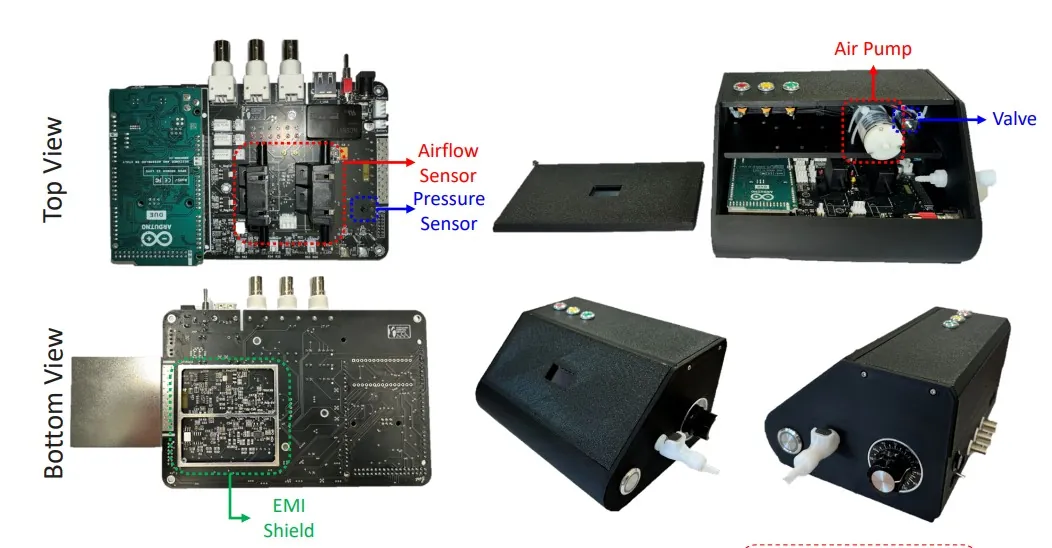
Custom 4-layer board with pump/valve drivers, instrumentation amp for cuff pressure, ECG AFE, MCU, and isolated USB. I did the schematics, layout, BoM, and bring-up.
Flagship project · $2.7M NIH-funded · multi-site clinical study
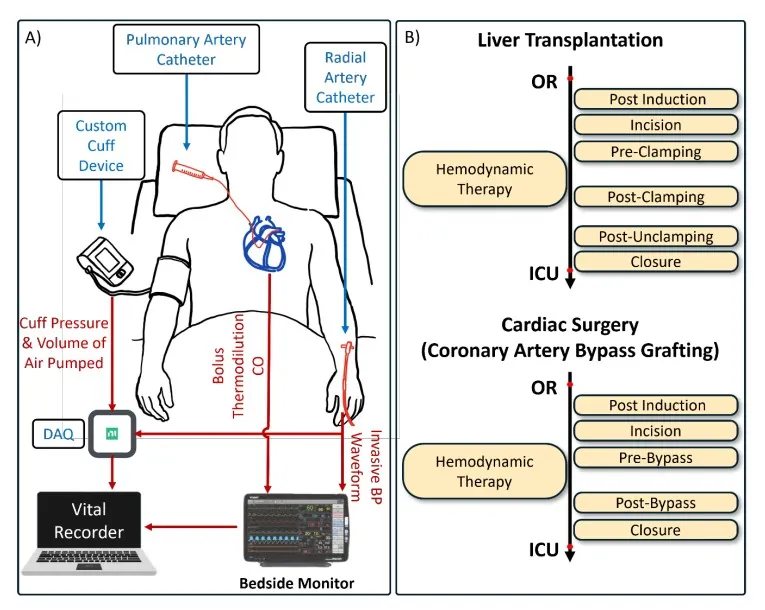
A standard arm cuff, rebuilt from the analog front end up, that estimates cardiac output, blood pressure, ECG, and respiration in one cycle. Tested against catheter references in 34 surgical patients.
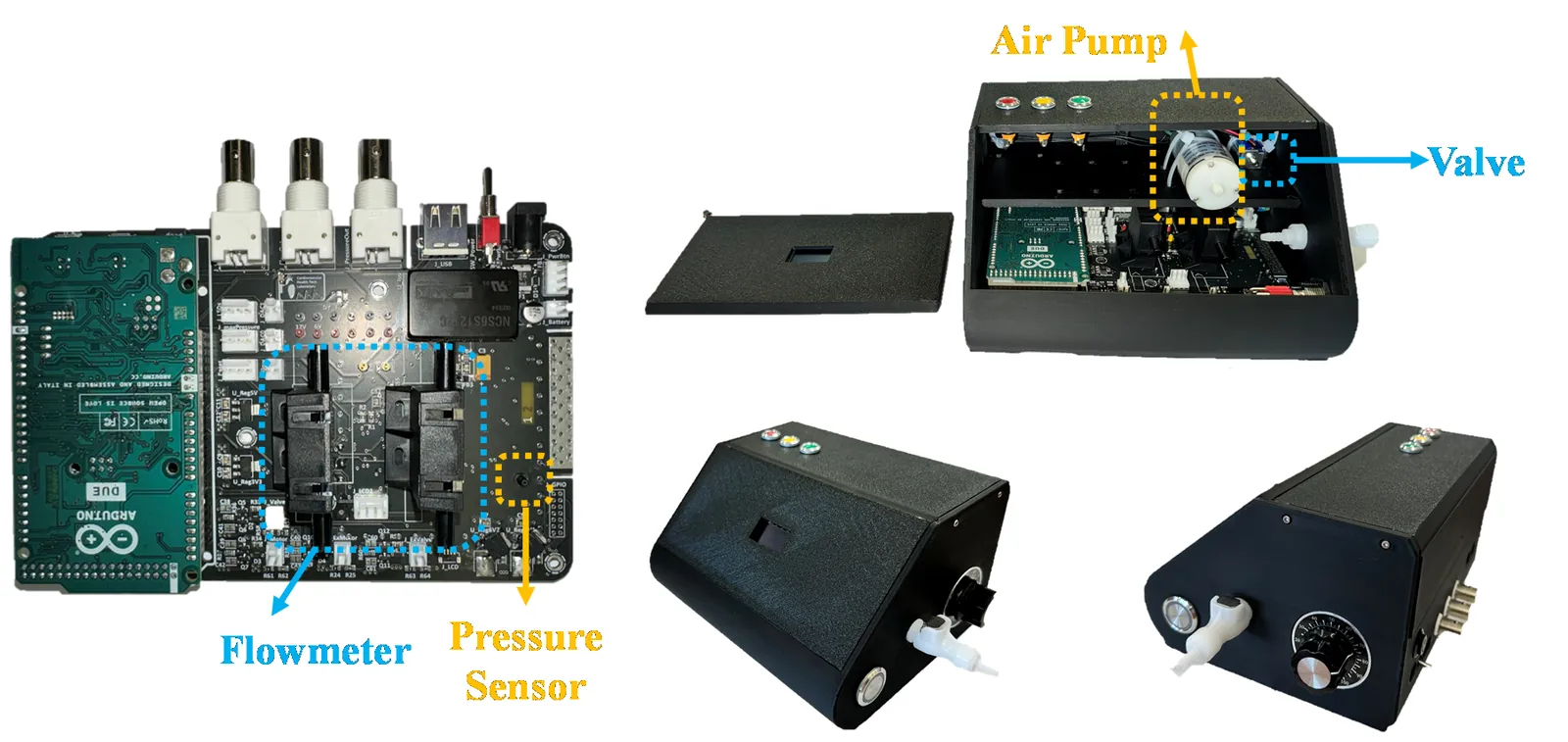
In the OR and ICU, the numbers that decide between a fluid bolus and a vasopressor come from catheters threaded through the chest. Catheters are accurate. They are also invasive, expensive, and unavailable outside the OR or ICU.
Smart Cuff asks how much of that information is in the brachial artery, where a $30 cuff already sits. After three years of hardware, firmware, signal pipelines, and clinical data, my answer is: more than the field assumed.
One automatic inflation gives four signals: the pneumatic pressure trace, an ECG lead, the cuff-coupled respiration signal, and the oscillometric envelope. From those four, a physics-based model estimates cardiac output, BP, HRV, and respiratory rate in one cycle, with no catheter.
Correlation with thermodilution was r = 0.60 (invasive pulse contour: r = 0.62). The result that matters is the trend: the cuff tracked changes as well as an invasive pulse-contour catheter, without going inside the patient. The goal is not to replace the catheter in the OR. It is to bring this kind of monitoring to the wards, the post-op floor, and eventually the home.
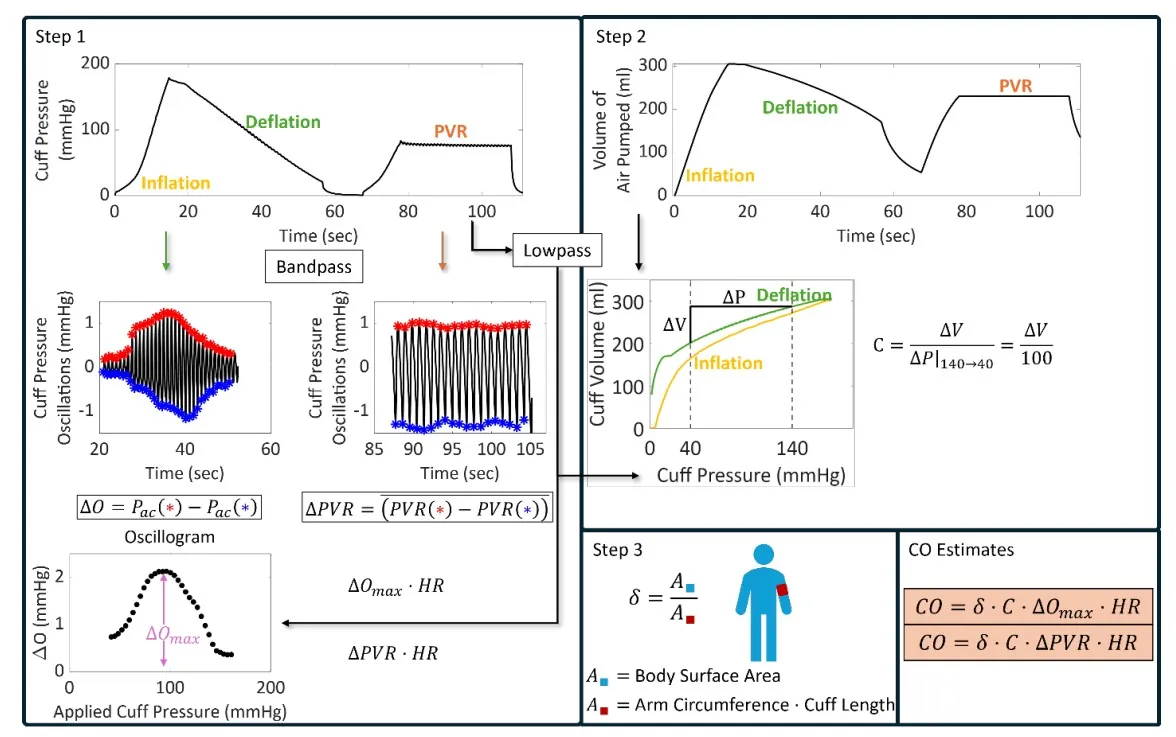
Closed-loop PID drives the pump up past 180 mmHg, pinching the brachial artery shut. The pressure trace becomes a clean carrier that is subtracted later.
Calibrated valve releases air at a controlled rate (~3 mmHg/s). The artery reopens once per heartbeat in the band where transmural pressure crosses zero, leaving a tiny oscillometric ripple on top of the slow ramp.
Bandpass + harmonic-SNR gating pull the oscillometric envelope out of the cuff signal. ECG comes in cleanly on its own front-end; respiration shows up as a slow modulation on the cuff baseline.
Pulse pressure, envelope shape, R-to-pulse delay, and beat-to-beat amplitude variance carry independent information about stroke volume, vascular tone, and respiratory loading.
Quality gates reject windows where the harmonic SNR is too low, motion artifact too high, or arrhythmia confuses the envelope. A bad estimate is worse than no estimate.
Custom 4-layer board with pump/valve drivers, instrumentation amp for cuff pressure, ECG AFE, MCU, and isolated USB. I did the schematics, layout, BoM, and bring-up.
Two-loop control: outer pressure setpoint, inner valve duty cycle. Anti-windup, slew limiting, and venting interlocks so a wedged valve can’t over-pressurize the cuff.
Each valve gets a piecewise-linear flow-vs-duty curve. Re-cal procedure in the GUI takes ~30 seconds per device and survives months of bench use.
PyQt6 protocol runner: pre-flight checks, safety thresholds, real-time PPG/ECG/pressure plots, event annotation, CSV/EDF export. Two clicks from idle to recording.
Hold below DBP to track beat to beat on the wards, with pressure-dependent amplification and on-line recalibration. Most of the work is the safety design.
A single number per measurement, derived from harmonic SNR, motion, and arrhythmia detection. Bad readings get rejected before a clinician ever sees them.
Same pipeline, smaller pump, lower duty cycle. Strip the OR-grade ECG, keep the cuff. Unattended morning and evening readings for heart-failure and post-op patients.
Happy to walk through the pipeline, the clinical study design, or the hardware. Email is fastest.